Drawing contemporary approach refers to the evolving methods and philosophies that artists use to create works on paper, canvas, or digital surfaces, characterized by experimentation with materials, conceptual depth, and a break from strict realism or traditional techniques. In Canada’s art landscape, this approach reflects the country’s multicultural fabric, where Indigenous perspectives, immigrant narratives, and regional identities converge to redefine what drawing can be and say in 2026.
This approach matters because it captures the present moment. Contemporary drawing isn’t bound by the constraints of classical training or representational accuracy. Artists blend charcoal with found objects, layer digital projections over hand-drawn marks, or use the act of drawing as performance. The result is work that often challenges viewers to reconsider the boundaries between disciplines and the role of the artist as storyteller, commentator, or community voice.
Across Canada, from public galleries in Toronto to artist-run centres in Vancouver and community studios in Winnipeg, contemporary drawing has become a site for dialogue. It addresses themes like displacement, climate anxiety, and cultural reclamation. Indigenous artists, for instance, use drawing to connect ancestral knowledge with modern expression, while newcomers to Canada employ the medium to navigate identity and belonging. Festivals celebrating multiculturalism frequently showcase contemporary drawing as a bridge between generations and traditions, proving the medium’s adaptability and relevance.
This article will define what contemporary drawing means in practical terms, explain how artists apply the approach in their studios and public spaces, identify the main types or methods that characterize the practice, and explore where and why it’s used in Canada’s cultural sector. Whether you’re an educator looking to bring fresh perspectives into the classroom or an art enthusiast curious about current trends, understanding this approach offers insight into how creativity shapes and reflects Canadian society today.
What the Contemporary Approach to Drawing Means
Contemporary drawing moves beyond putting pencil to paper in service of realistic representation. Instead, it treats drawing as an open-ended investigation, a way of thinking, questioning, and responding to the world rather than simply recording it. Where traditional academic drawing emphasized mastery of proportion, perspective, and technical skill to achieve likeness, contemporary approaches embrace experimentation, conceptual depth, and personal or cultural expression. The line itself becomes a vehicle for ideas, emotions, and stories that resist tidy categories.
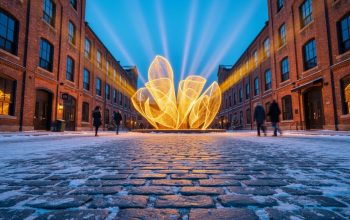
This shift reflects broader changes in how art functions. Contemporary drawing doesn’t confine itself to sketchbooks or framed works on gallery walls. Artists now draw on warehouse floors, project light onto buildings, trace gestures in augmented reality, or layer graphite with video stills and fabric scraps. The act of making marks, whether with charcoal, stylus, soil, or shadow, matters as much as the finished image. Canadian practitioners have leaned into this expansiveness, using drawing to explore the nation’s multicultural identity, Indigenous knowledge systems, immigrant experiences, and environmental concerns.
Several concepts anchor contemporary drawing practice:
- Process-based drawing
- Work where the unfolding act of drawing holds equal or greater importance than the final image, often documented through time-lapse, residue, or ephemeral traces.
- Mark-making
- Any intentional gesture that leaves a trace, expanding drawing beyond traditional tools to include body movements, digital brushes, or unconventional implements like coffee, ash, or thread.
- Hybrid practices
- Drawing that fuses multiple disciplines, sculpture, performance, photography, sound, blurring where one medium ends and another begins.
- Site-responsive drawing
- Work created in direct dialogue with a specific location, incorporating its history, materials, or spatial qualities into the drawing itself.
- Performative drawing
- Drawing executed as a live event, often involving the artist’s body in choreographed or improvised movements that generate marks over time.
Materials have exploded beyond graphite and charcoal. Contemporary Canadian artists work with digital tablets and projection mapping alongside traditional media. They draw on unconventional surfaces, gallery windows, shipping containers, human skin, the land itself. Mixed media assemblages combine ink with found photographs, text fragments, and three-dimensional elements, turning drawings into relief sculptures or installations you can walk through.
What truly distinguishes this approach is its conceptual framework. Contemporary drawing asks questions. It probes memory, challenges colonial narratives, maps personal geographies, or documents change. Canadian artists from diverse backgrounds use drawing to navigate between cultures, languages, and histories. An artist of Chinese heritage might layer calligraphic gestures over maps of Vancouver’s shifting neighbourhoods. An Anishinaabe practitioner could draw with natural pigments to reclaim ancestral mark-making traditions. A Syrian-Canadian might sketch fragmented cityscapes that speak to displacement and resilience.
The boundaries between drawing and other art forms have become porous. Is a charcoal line animated into a short film still a drawing? What about marks scored into clay or traced with a laser cutter? Contemporary practice says yes, expanding drawing’s definition while honouring its fundamental impulse: the human need to leave a mark, to map thought onto surface, to communicate across time and space.
How Contemporary Drawing Practice Works
The Expanded Toolkit
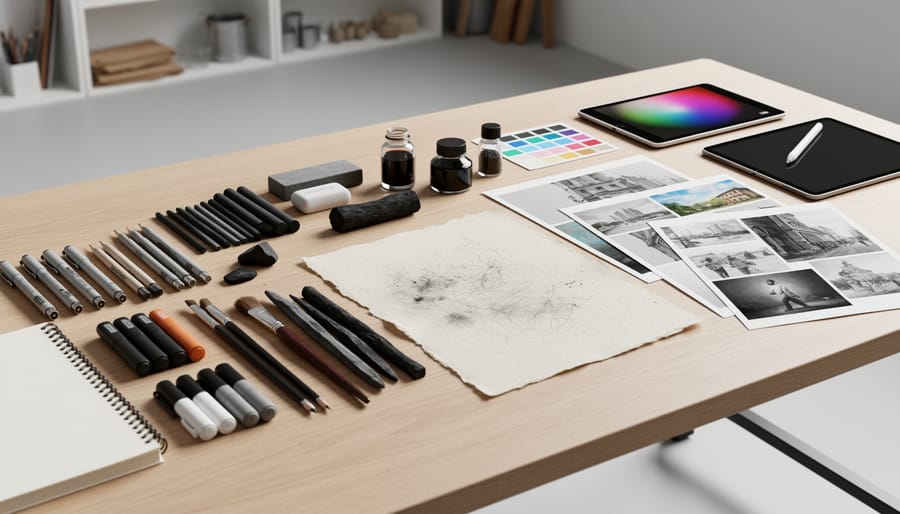
Contemporary Canadian artists have dramatically broadened what counts as a drawing tool, moving far beyond the pencil-and-paper tradition most people learned in school. Walk into a contemporary art studio today and you might find charcoal and graphite sitting alongside a digital tablet running Procreate, a can of spray paint, or even a custom-built mechanical arm that traces patterns across a wall.
Traditional materials still hold value, many artists return to conte crayon, ink, or silverpoint for their tactile qualities and historical resonance, but they now coexist with projection mapping systems that turn entire building facades into drawing surfaces. Artists like Krista Belle Stewart combine physical mark-making with augmented reality overlays, creating drawings that exist simultaneously in material and digital space.
The scale has exploded too. Installation drawing transforms gallery walls, floors, and windows into expansive fields for mark-making. Some artists work with architect’s tape to create geometric patterns that viewers can walk through; others use chalk, charcoal dust, or even coffee grounds to create room-sized compositions that evolve throughout an exhibition’s run.
Digital tablets and styluses offer infinite undo buttons and layer systems, but they also introduce new gestural possibilities through pressure sensitivity and tilt recognition. 3D modeling software extends drawing into virtual space, while laser cutters and CNC routers translate digital sketches into physical objects. The contemporary toolkit is less about replacing old methods than multiplying the ways artists can think through line, mark, and gesture.
Process as Product
In many contemporary Canadian drawing practices, the finished image matters less than the journey of making it. Artists treat drawing as a live event, a durational activity whose unfolding holds as much meaning as any static result. This shift reframes drawing from object to experience, inviting viewers to witness creation rather than simply consume a completed work.
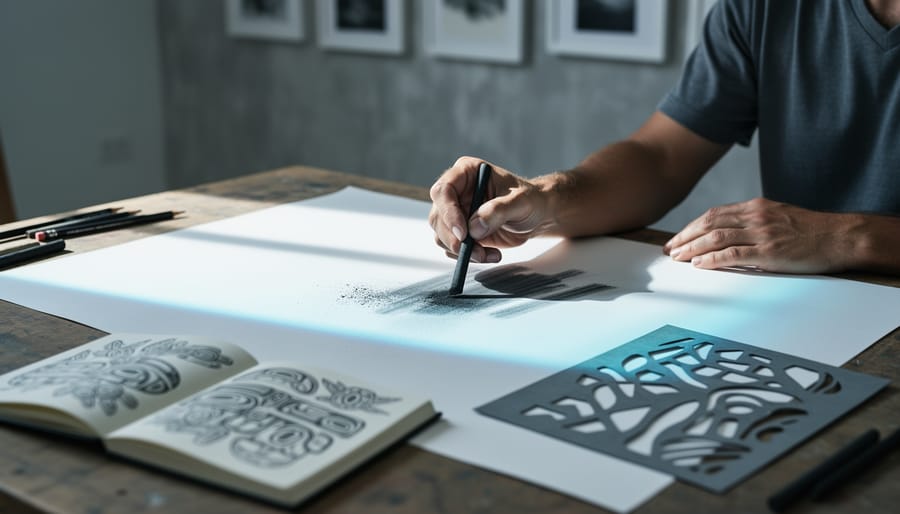
Time-based drawing captures this philosophy clearly. An artist might spend hours, days, or weeks building a single wall-scale piece in a gallery, allowing visitors to return and observe incremental changes. The accumulation of marks over time becomes a meditation on labour, presence, and transformation. Documentation, photographs, video, written notes, often functions as the primary artifact, preserving the ephemeral process once the physical work is erased or dismantled.
Performative drawing events take this further by centering the artist’s body and actions. In artist-run centres and festivals across Canada, practitioners stage public drawing sessions where gesture, rhythm, and audience interaction shape the outcome. These performances might involve large-scale charcoal gestures set to music, collaborative mark-making with community members, or improvised responses to spoken-word poetry. The drawing emerges as residue of the performance, not its sole purpose.
This approach aligns with broader themes in Contemporary Canadian Art Development: valuing process over product, democratizing art-making, and questioning who gets to define what counts as finished work. By documenting and sharing these acts, artists create archives of creative thinking visible to audiences who might never enter traditional gallery spaces. The marks left behind become evidence of presence, effort, and exchange, proof that drawing happened here.
Forms and Categories of Contemporary Drawing
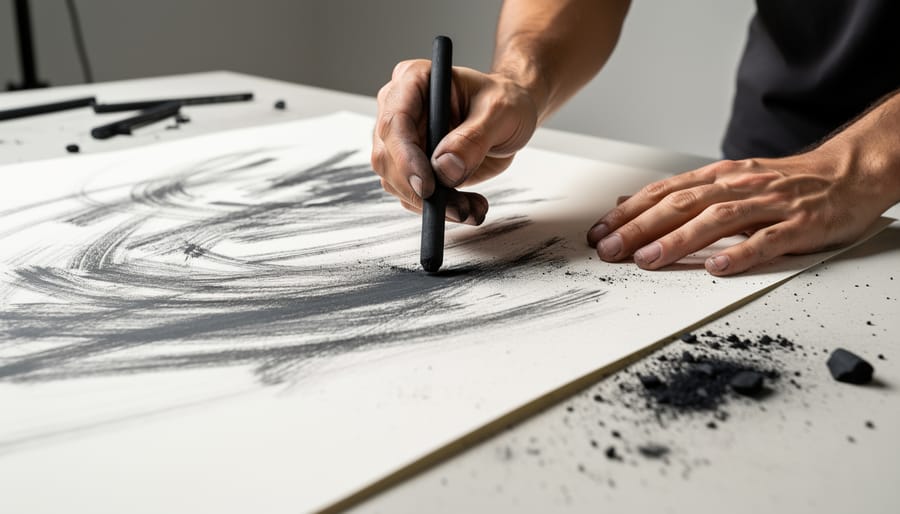
Contemporary drawing in Canadian art today refuses a single definition, instead branching into distinct yet overlapping modes that reflect the country’s experimental spirit and cultural diversity. These categories aren’t rigid boxes, artists frequently move between them or combine approaches within a single project, but they offer a useful framework for understanding the range of practices shaping Canada’s drawing landscape right now.
Installation and spatial drawing transforms the act of mark-making into an immersive environment. Artists work directly on walls, floors, and ceilings of gallery spaces, often creating site-specific works that viewers can walk through or around. Charcoal dust might cover an entire room, lines of tape stretch across architectural features, or projected marks animate surfaces in real time. This approach pulls drawing off the page and into physical space, inviting viewers to experience scale, movement, and their own bodily relationship to the work. Many Canadian galleries and artist-run centres have embraced this category, commissioning temporary drawing installations that exist only for the exhibition’s duration.
Narrative and sequential drawing borrows from graphic novels, storyboarding, and cinematic thinking to build layered stories through series of images. Canadian artists working in this mode often tackle themes of migration, family history, and cultural memory, creating visual essays that unfold across multiple panels or pages. The work can be intimate, small sketchbooks documenting daily life, or ambitious, room-spanning sequences that function like visual novels. This category overlaps with illustration and comics but distinguishes itself through conceptual depth and gallery presentation.
Abstract and gestural drawing emphasizes the physical act of making marks, prioritizing energy, rhythm, and material experimentation over representational content. Artists might use unconventional tools, sticks, brushes, body parts, and work on unexpected surfaces. The results range from delicate, meditative line work to explosive, large-scale gestures. This approach connects to historical abstraction but contemporary practitioners often layer in cultural references or performative elements, making the work about both form and meaning.
Social practice and participatory drawing brings the public into the creative process. Artists set up drawing stations in community centres, organize collaborative mural projects, or facilitate workshops where participants contribute to evolving artworks. This category positions drawing as a tool for dialogue, relationship-building, and collective expression rather than solitary studio practice. In Canada’s diverse urban centres, these projects frequently become spaces for cross-cultural exchange and shared storytelling.
Indigenous-informed drawing practices represent a vital and growing category within Canadian contemporary art. Artists drawing on First Nations, Métis, and Inuit knowledge systems approach mark-making through culturally specific worldviews, what scholars describe through frameworks like Plains Cree ontology which emphasizes relational thinking and animate connections between beings. These practices might incorporate traditional iconography, land-based materials, or ancestral techniques within contemporary contexts, creating work that challenges Western art-historical categories while asserting Indigenous artistic sovereignty.
The major categories shaping contemporary drawing in Canada today include:
- Installation & Spatial Drawing, immersive, site-specific environments that activate architectural space
- Digital & New Media Drawing, works created with tablets, projection, animation, and generative software
- Social & Participatory Drawing, community-engaged projects where drawing becomes collaborative dialogue
- Indigenous Knowledge-Based Drawing, practices rooted in First Nations, Métis, and Inuit worldviews and visual languages
- Hybrid & Cross-Disciplinary Drawing, approaches that blend drawing with performance, sculpture, sound, or text
What makes these categories distinctly contemporary isn’t just their departure from academic tradition, it’s how they reflect Canada’s specific cultural moment. The prominence of Indigenous-informed practices responds to ongoing reconciliation efforts and growing recognition of Indigenous artistic leadership. Social practice drawing aligns with the country’s emphasis on multiculturalism and community-building. Installation work flourishes in a gallery ecosystem that values experimentation and temporary, event-based exhibitions over permanent collection-building.
Artists rarely announce which category they’re working in; the classifications emerge from how the work functions and what questions it asks. A single artist might create spatial installations one year and intimate narrative sequences the next, or develop a practice that genuinely spans multiple categories at once. The flexibility itself matters, it signals that contemporary drawing in Canada values adaptability, cultural responsiveness, and the rejection of formulaic approaches.
Where and How Contemporary Drawing Is Used in Canada

Contemporary drawing in Canada flourishes across an interconnected network of institutions, public spaces, and community settings, each offering distinct opportunities for artists to experiment and connect with audiences.
Public galleries and museums regularly feature contemporary drawing in solo exhibitions, thematic group shows, and biennial surveys. The National Gallery of Canada, Art Gallery of Ontario, and Vancouver Art Gallery have dedicated programming highlighting drawing’s expanded practice, while artist-run centres like Artspace in Peterborough, TRUCK Contemporary Art in Calgary, and Eastern Edge in St. John’s provide crucial platforms for emerging voices and experimental work. These spaces often commission site-specific drawing installations that respond to architectural features or community narratives, transforming entire rooms into immersive mark-making environments.
Public art programs across Canadian cities increasingly incorporate drawing-based projects. Transit stations, library walls, and civic plazas host large-scale murals, projection-mapped drawings, and temporary chalk or charcoal interventions that invite passersby into dialogue. Vancouver’s Mural Festival and Montreal’s MURAL event showcase monumental drawing works that blend street art traditions with contemporary conceptual approaches, making art accessible beyond gallery walls.
Educational institutions serve as vital laboratories for contemporary drawing practice. University fine arts programs and community art schools foster creativity through open-ended drawing studios, interdisciplinary workshops, and visiting artist residencies. K-12 programs increasingly incorporate contemporary drawing methods into multicultural art education encouraging students to explore identity and storytelling through mixed-media mark-making.
Community engagement projects use drawing as a tool for collective memory-building and social connection. Drawing circles, blind contour portrait exchanges at multicultural festivals, and collaborative mural projects bring together diverse participants regardless of skill level. Indigenous communities host drawing workshops that weave traditional knowledge with contemporary techniques, while newcomer settlement organizations use drawing as a cross-language bridge for expression.
Interdisciplinary collaborations place drawing in unexpected contexts: theatre designers create live projections during performances, architects sketch directly onto building facades during design festivals, and scientists partner with artists to visualize research data through hand-drawn infographics. These intersections demonstrate drawing’s adaptability as both investigation method and communication tool across Canada’s creative sectors.
Contemporary Drawing and Canadian Multiculturalism
Canada’s diverse population generates a distinctive context for contemporary drawing, one where artists layer personal heritage, collective memory, and cross-cultural dialogue onto every mark. This richness stems directly from the nation’s multicultural identity built through decades of immigration policies that prioritized inclusion. Drawing becomes a vehicle for navigating what it means to belong in a place defined by multiplicity rather than singular tradition.
Indigenous artists reclaim drawing as a tool for cultural continuity and political assertion. Rebecca Belmore uses charcoal and conte on paper to map trauma and resilience, while artists like Meryl McMaster blend photographic self-portraiture with hand-drawn elements that reference ancestral knowledge and land-based practices. These works challenge colonial art-historical narratives and assert drawing’s role in truth-telling and healing.
Asian-Canadian artists such as Ken Lum and Paul Wong employ drawing to examine diasporic experience, language barriers, and the construction of identity across borders. Lum’s text-based drawings interrogate stereotypes and urban space, while Wong’s performative drawing actions document the body as a site of cultural negotiation. Their work often references calligraphic traditions while resisting easy categorization, creating hybrid visual languages.
African-Canadian and Caribbean-diaspora artists use drawing to trace migration routes, familial histories, and Afrofuturism. Sandra Brewster’s graphite and mixed-media portraits layer memory and erasure, capturing the fragmented nature of diasporic identity. Her process involves photocopying, drawing, and rubbing, physical acts that mirror the passage of time and the effort required to preserve stories often marginalized in official histories.
Festivals across Canada provide platforms for these diverse drawing practices. Events like Nuit Blanche Toronto, Indigenous Art Days in Winnipeg, and Vancouver’s Capture Photography Festival regularly feature drawing installations and live drawing performances that celebrate cultural difference. Artist-run centres in cities with significant immigrant populations, such as Montreal’s Centre Clark or Calgary’s Stride Gallery, prioritize programming that foregrounds multicultural perspectives, ensuring contemporary drawing remains a space where multiple voices coexist, overlap, and redefine what Canadian art looks like today.
Frequently Asked Questions
What makes drawing ‘contemporary’ rather than traditional?
Contemporary drawing embraces experimental materials, conceptual frameworks, and often blurs the line between drawing and other art forms like installation or performance. It prioritizes ideas, process, and cultural dialogue over technical skill alone, and frequently challenges what a drawing can be or do.
Do I need formal art training to practice contemporary drawing?
No formal training is required. Many contemporary artists are self-taught or come from non-traditional backgrounds. What matters more is developing your unique visual language, engaging with ideas, and being willing to experiment with materials and processes.
How is contemporary drawing different from illustration?
Illustration typically serves a specific communicative function, visualizing a text, product, or message for an audience. Contemporary drawing prioritizes personal expression, conceptual exploration, and often exists as fine art without needing to illustrate something external to itself.
Where can I see contemporary drawing in Canada?
Major public galleries like the Art Gallery of Ontario and National Gallery of Canada regularly feature drawing exhibitions. Artist-run centres in cities across the country showcase emerging practices, and many universities host annual drawing shows open to the public.
How do contemporary drawing artists earn a living?
Artists combine multiple income streams: selling work through galleries and online platforms, public art commissions, teaching workshops or university courses, artist residencies with stipends, and grant funding from arts councils. Many balance studio practice with teaching, design work, or related creative employment.
Is digital drawing considered contemporary art?
Yes, when it engages with contemporary ideas and contexts. Digital tools are simply part of the expanded toolkit, what matters is how the artist uses them to explore concepts, respond to culture, or push the boundaries of what drawing can express.
These questions reflect genuine curiosities from people encountering contemporary drawing practices for the first time, especially within Canada’s varied art landscape. The accessibility question matters because the contemporary art world can feel exclusive or gatekept, yet many of today’s most interesting drawing practices emerge from artists who’ve found their own paths outside academic structures.
The distinction between drawing and illustration trips up viewers regularly at gallery openings and artist talks. Both involve mark-making, but their purposes diverge. An illustrator might render a beautiful portrait to accompany a magazine profile. A contemporary artist might draw a portrait that explores colonialism’s visual legacy or uses the human face as a starting point for abstract experimentation.
Career sustainability remains a practical concern. The romantic image of the starving artist persists, but successful contemporary practitioners build diversified practices. They might teach a university drawing course, run summer workshops, accept a public art commission for a new transit station, apply for project grants, and maintain studio production simultaneously. This portfolio approach lets artists sustain their practice while remaining embedded in their communities and the broader art ecosystem.
The contemporary approach to drawing has become an essential force in Canada’s artistic evolution, reflecting the nation’s commitment to experimentation, cultural dialogue, and creative risk-taking. By expanding beyond traditional boundaries, drawing now serves as a vital medium for exploring identity, memory, and social questions that matter to Canadians from coast to coast.
This shift toward interdisciplinary practices and inclusive storytelling mirrors the country’s broader cultural values. Artists working today draw from diverse traditions, technologies, and lived experiences, creating work that speaks to multiple communities while pushing the medium into new territories. The result is a vibrant, constantly evolving practice that refuses to be confined by convention.
For those interested in experiencing this energy firsthand, Canada offers numerous opportunities. Visit contemporary galleries, attend artist talks at university art departments, or participate in community drawing workshops that welcome all skill levels. Many institutions receive government funding to support public programming, making contemporary art more accessible than ever.
As Canada’s cultural landscape continues to diversify and its artists embrace new tools and ideas, drawing will remain a dynamic site of innovation. The medium’s immediacy and flexibility ensure it will adapt alongside the communities it serves, carrying forward the conversations, experiments, and visions that define Canadian art today.