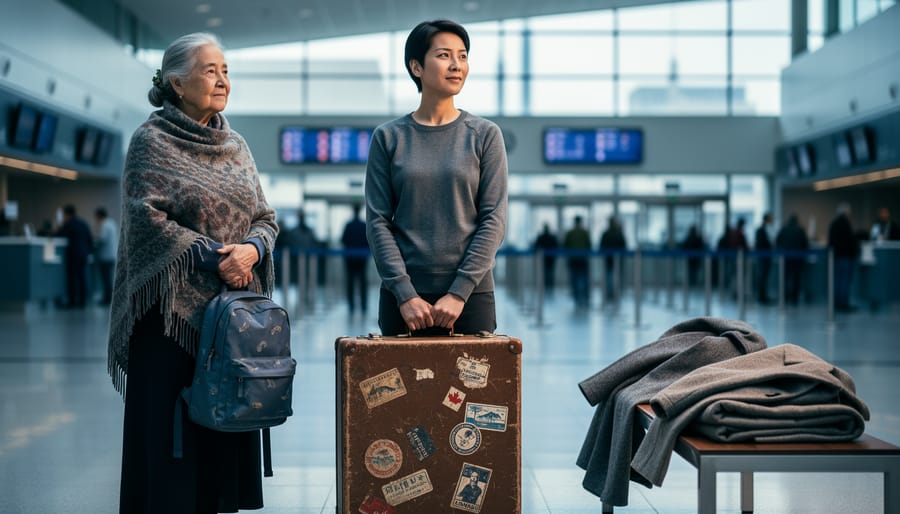
Canada has restricted immigration for most of its history, and the rules were often openly selective: they welcomed some newcomers and shut out others based on where they came from. The Chinese head tax of 1885, the 1908 continuous journey regulation that blocked most arrivals from South Asia, and the Chinese Immigration Act of 1923 are among the best-known examples. Over time, these barriers gave way to the points-based, non-discriminatory system that began taking shape in the 1960s and 1970s. Today, eligibility rests on factors like skills, family ties, and protection needs rather than origin.
Understanding that arc matters, because it explains why so many Canadian communities carry stories of waiting, separation, and eventual belonging.
Think of a grandmother at a Lunar New Year gathering or a Vaisakhi parade, tracing her family’s journey back through decades of paperwork and policy. Those celebrations, now fixtures of Canadian life, exist partly because people endured the very restrictions this article explores. Below, you’ll find a clear timeline of what was imposed and when, how eligibility has shifted, what rights and obligations come with different statuses, and where to turn for official help.
What Canadian Immigration Restrictions Were and Why They Existed

Reading the Rules Through Their Era
When Canada became a country in 1867, its leaders faced a practical puzzle: how do you build a nation across a vast, thinly settled territory? Their answer was growth. Railways needed workers, prairie farmland needed homesteaders, and a young economy needed labour and customers.
Out of that thinking came a narrow picture of the “ideal” newcomer. Officials generally favoured settlers from Britain and northern Europe, along with farmers who could work the land. They believed these groups would blend quickly into the existing society, an assumption shaped by the prejudices and racial theories widely accepted at the time.
Understanding this mindset isn’t the same as agreeing with it. Many of the rules that followed were built on ideas we now recognize as discriminatory, and seeing the reasoning behind them helps explain why certain communities were welcomed while others were turned away or taxed for arriving.
A Timeline of Restrictions: From the Head Tax to the Points System

Voices From the Docks: Stories Behind the Laws
Behind every clause in these laws was a family trying to make a life. Picture a Chinese labourer in the 1890s who had helped lay track through the Rockies, saving for years to pay the head tax under the act only to find that his wife and children still could not afford to join him. Many families stayed apart for decades, connected by letters and remittances sent across the Pacific.
In 1914, nearly 400 passengers from British India, mostly Sikh, waited aboard the Komagata Maru in Vancouver’s harbour. Because of the continuous journey regulation almost all were refused entry. They spent two months on that ship, sustained by their community onshore, before being sent back.
Later, in 1923, a new law virtually excluded Chinese immigration and Chinese Canadians marked its July 1 passage as “Humiliation Day.”
| Year | Law or Regulation | Communities Most Affected | What Changed or How It Ended |
|—|—|—|—|
| Year | Law or Regulation | Communities Most Affected | What Changed or How It Ended |
|---|---|---|---|
| 1885 | Chinese Immigration Act (head tax) | Chinese migrants and families | Tax rose over time, then was replaced by exclusion in 1923 |
| 1908 | Continuous journey regulation | South Asian migrants, including Sikhs | Later superseded as selection moved away from origin-based rules |
| 1923 | Chinese Immigration Act (Exclusion Act) | Chinese Canadians | Repealed in 1947 |
At Pier 21 in Halifax, though, a quieter story played out for many who were admitted. Newcomers stepped off ships carrying small suitcases and big hopes, greeted by volunteers who offered a cup of tea and a train ticket onward. These moments of welcome sit alongside the exclusions, and together they remind us how uneven the doorway to Canada once was.
Who Was Eligible, Who Was Excluded: How Selection Criteria Shifted Over Time

For much of Canada’s history, the question “Who may come?” had less to do with a person’s skills than with where they were born. In the late 1800s and early 1900s, officials sorted newcomers into a kind of ladder. British and American settlers sat at the top, followed by northern and western Europeans, then southern and eastern Europeans, who were admitted mainly when the country needed labour. Asian, Black, and many other applicants were pushed to the bottom or shut out altogether.
Occupation mattered too, but only within those limits. Farmers and farm labourers were welcomed because the Prairies needed settling. Women could often enter as domestic workers, a role Canadian households badly needed to fill. Meanwhile, the same jobs might be closed to applicants from “non-preferred” countries, no matter how qualified they were.
Admission could also be denied on grounds that had nothing to do with work. Over the decades, officials turned people away for reasons including:
- Country or race of origin, which decided who was “preferred” and who was restricted.
- Occupation, favouring farmers, labourers, and domestic workers during settlement booms.
- Financial means, from head tax payments to proof of money on arrival.
- Health screening, which could bar people with certain illnesses or disabilities.
- Sponsorship or family ties, which sometimes eased entry for relatives and sometimes did not.
- Political beliefs, with suspected radicals and activists turned away in some periods.
- Points-based assessment, introduced in 1967 to score applicants on skills, education, and language.
Ideology could close the door as well. After the First World War and again during the Cold War, people suspected of holding certain political views faced extra scrutiny or outright refusal.
The shift came in the 1960s. By 1962, race and national origin were removed as official grounds for selection, and in 1967 the points system made the new approach concrete. Applicants were now assessed on factors like education, work experience, language ability, and family connections in Canada. It was far from perfect, but for the first time the rules looked at what a person could contribute rather than where their ancestors came from. That change helped open the way for the diverse communities, and the festivals, we celebrate across the country today.
Rights and Obligations: What Newcomers Faced Then and What Residents Are Entitled To Now
For much of the late nineteenth and early twentieth centuries, arriving in Canada did not mean arriving with equal rights. Many newcomers faced restricted voting, barriers to certain jobs, mandatory registration, and, under the head tax and exclusion rules, long separations from spouses and children. A worker could build a railway or run a laundry and still be treated as a permanent outsider by law.
Today’s framework looks very different. The Immigration and Refugee Protection Act sets out how people are selected, how families can reunite, and how refugees are protected. The Canadian Charter of Rights and Freedoms guarantees fundamental freedoms, legal rights, and equality protections to everyone on Canadian soil, with a handful of rights, such as voting, reserved for citizens.
In general terms, permanent residents can live, work, and study anywhere in Canada, and they can access public health care and social benefits, depending on the province. They must meet residency requirements to keep their status and follow Canadian laws. Citizens gain the right to vote, to run for office, to hold a Canadian passport, and to enter the country freely, along with duties such as obeying the law and, when called, serving on a jury.
Those rights shape real lives. The way newcomers can now work and study is part of why immigrant contributions show up in nearly every industry, from health care to small business. Settlement programs, language classes, and public schools that rely on government funding help families put those rights into practice.
Knowing where the law once fell short helps explain why these protections matter, and why so many communities continue to celebrate them.
Acknowledgment, Redress, and the Road to Multiculturalism

On June 22, 2006, Prime Minister Stephen Harper stood in the House of Commons and apologized for the head tax and the Chinese Immigration Act of 1923. Families who had waited generations for those words sat in the gallery. Redress payments followed for surviving head tax payers and spouses, and community funds were set up to support education and remembrance projects.
Ten years later, on May 18, 2016, Prime Minister Justin Trudeau apologized in the House for the Komagata Maru incident of 1914, when 376 passengers from British India were turned away at Vancouver’s harbour under the continuous journey rule. Other acknowledgments belong to this same story, including the 1988 redress for the wartime internment of Japanese Canadians and the 2018 apology to the passengers of the MS St. Louis, the ship of Jewish refugees denied refuge in 1939.
These apologies didn’t arrive in isolation. They grew out of decades of community organizing, oral history gathering, and quiet persistence by families who refused to let the stories fade. They also sit alongside the policy shifts that reshaped the country: the 1971 multiculturalism policy and the 1988 Canadian Multiculturalism Act, which formally recognized diversity as a fundamental feature of Canadian society. Understanding that arc helps explain how Canada’s multicultural identity was built, and why it’s still a work in progress. Those who study multicultural success often point to this willingness to name past wrongs.
Remembrance also lives in celebration. Chinese New Year parades fill the streets of Vancouver and Toronto with lion dancers and red lanterns. Vaisakhi parades bring tens of thousands of people together each spring, many sharing free food along the route. Caribana turns Toronto’s waterfront into a carnival of Caribbean music, costume, and pride. Heritage months, from Asian Heritage Month in May to Black History Month in February, bring talks, exhibits, and performances into libraries and community halls.
These events invite everyone in, whether or not you share the heritage being honoured. Many schools now build on them, and the growth of multicultural classrooms means students can learn this history while joining in the festivities.
Where to Get Help and Learn More
Learning about past restrictions often leads to a personal question: where do I go next? The answer depends on whether you’re digging into history or dealing with a live immigration matter, and mixing the two up can cost you time.
If you’re tracing a family story or studying the records, start with Library and Archives Canada, which holds passenger lists, naturalization files and other historical immigration documents. The Canadian Museum of Immigration at Pier 21 in Halifax offers exhibits, oral histories and a research centre. Local multicultural heritage organizations and community archives often hold photographs, letters and stories you won’t find in a national collection.
If you’re handling a current matter, such as an application, a status question or a sponsorship, go to Immigration, Refugees and Citizenship Canada (IRCC), the official source for current rules and forms. Settlement and newcomer services agencies across the country offer free help with language, housing, jobs and orientation. Community legal clinics can guide people who can’t afford a lawyer. For anything involving an application or a legal risk, work with a licensed immigration lawyer or a regulated Canadian immigration consultant, and be wary of anyone who isn’t licensed.
What was the head tax?
It was a fee charged to Chinese immigrants entering Canada, introduced by the Chinese Immigration Act of 1885 and raised in later years. It was meant to discourage Chinese immigration, and it was formally acknowledged with a redress and apology in 2006.
Can I find my ancestors’ immigration records?
Often, yes. Library and Archives Canada holds many historical immigration and naturalization records, and the Pier 21 museum can point you toward further research help.
Where can newcomers get settlement support today?
Settlement and newcomer services agencies offer free help with language, housing and employment. IRCC’s website can help you find services near you.
Whichever path you take, official rules change, so confirm current details directly with government sources.
Every law we’ve traced here began as a decision made far from the people it touched, yet its effects landed in kitchens, boarding houses, and train stations across the country. Knowing how head taxes, quotas, and closed doors shaped lives helps us see today’s communities for what they are: places built by people who often arrived despite the rules, not because of them.
That understanding changes how a festival feels. The drums at a Lunar New Year parade, the colour of a Vaisakhi procession, the steel pans drifting through summer streets carry stories of persistence. They are part of the longer arc of Immigration Policies in Canadian History, and a reminder of how far the story has moved.
So ask a grandparent, a neighbour, or a friend how their family came here. Every household holds a chapter worth hearing, and sharing it keeps the whole story growing.