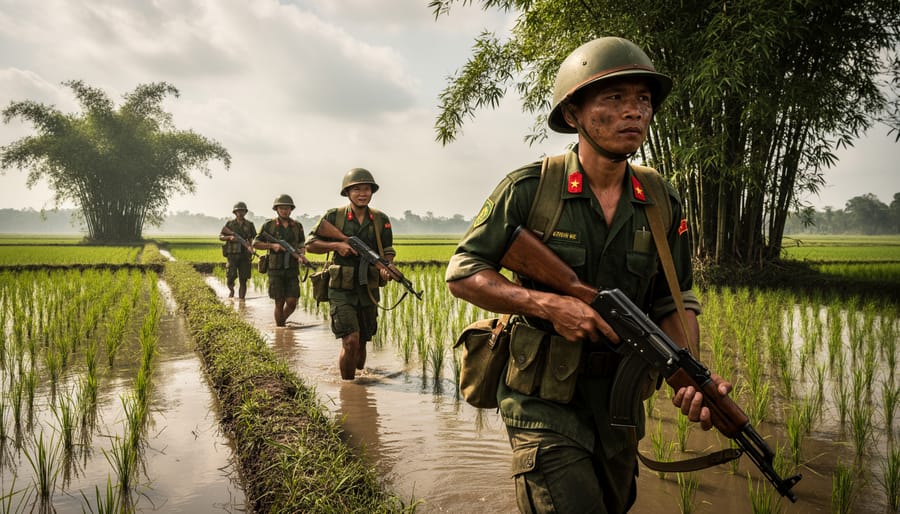
Vietnam’s military history spans more than two millennia of resistance, tactical innovation, and determination to preserve sovereignty against far larger powers. From ancient victories against Chinese dynasties to modern conflicts with France and the United States, Vietnamese forces developed a distinct martial tradition characterized by guerrilla warfare, intimate knowledge of terrain, and the mobilization of entire populations for defense. This legacy of military achievements reflects not merely battlefield success but a cultural ethos of self-determination that continues to shape national identity.
Understanding Vietnam’s martial past offers insight into how a relatively small nation maintained independence through centuries of conflict. The Vietnamese developed unique military strategies that compensated for numerical and technological disadvantages, strategies that would later influence liberation movements worldwide. From the legendary Trung Sisters’ rebellion in 40 CE to General Vo Nguyen Giap’s triumph at Dien Bien Phu in 1954, Vietnamese commanders consistently outmaneuvered opponents through patience, adaptability, and deep understanding of their homeland.
For Canadian readers, particularly those within Vietnamese diaspora communities, this history represents more than distant battles. It illuminates the resilience and ingenuity that Vietnamese Canadians brought to their adopted country. The same cultural values that sustained Vietnam through centuries of warfare have enriched Canada’s multicultural fabric, contributing to our collective appreciation for perseverance and strategic thinking. This exploration traces Vietnam’s military evolution chronologically, examining how each era built upon previous experiences to create one of history’s most remarkable defensive traditions.
Ancient Foundations: Early Vietnamese Military Resistance
The Trung Sisters and the Spirit of Resistance
In 40 CE, two Vietnamese noblewomen, Trung Trac and Trung Nhi, launched a rebellion that would become the defining symbol of Vietnamese resistance for two millennia. Outraged by the execution of Trung Trac’s husband by a Chinese mandarin and the oppressive taxation and cultural suppression under Han dynasty rule, the sisters mobilized an army of approximately 80,000 fighters, remarkably, including several female generals. Within months, they liberated 65 citadels across the Red River Delta, temporarily expelling Chinese forces and establishing an independent kingdom with Trung Trac as queen.
Their military strategy combined conventional pitched battles with knowledge of local terrain, utilizing Vietnam’s network of rivers and rice paddies to their advantage. The sisters trained their forces in both armed combat and psychological warfare, inspiring fighters through appeals to national identity and cultural preservation. Though the rebellion lasted only three years before Han reinforcements crushed it in 43 CE, with the sisters reportedly drowning themselves rather than surrendering, their impact transcended military defeat.
The Trung Sisters became immortalized in Vietnamese culture as symbols of courage, patriotism, and resistance against foreign domination. Temples dedicated to them exist throughout Vietnam, and their story is preserved in every military history museum focused on Vietnamese heritage. Their rebellion established a template for future Vietnamese resistance movements: fighting against superior forces through popular mobilization, strategic use of geography, and unwavering determination to preserve cultural identity.
Building a Martial Culture
Centuries of Chinese domination forged Vietnam into a warrior society where military preparedness became inseparable from daily life. Unlike many conquered peoples who gradually assimilated, the Vietnamese maintained a fierce independence that manifested in continuous resistance. Each generation inherited not just stories of past uprisings, but practical knowledge of irregular warfare refined through repeated cycles of rebellion and suppression.
This prolonged struggle created a distinctive military philosophy emphasizing patience, terrain mastery, and popular mobilization. Vietnamese commanders learned that direct confrontation with a larger, better-equipped force meant defeat. Instead, they developed tactics exploiting their intimate knowledge of dense jungles, complex river systems, and mountainous terrain. Hit-and-run attacks, ambushes at carefully chosen chokepoints, and strategic withdrawals into inaccessible regions became standard practice.
The integration of civilians into military operations emerged as another defining characteristic. Farmers doubled as soldiers, village networks provided intelligence, and entire communities supported guerrilla forces with supplies and refuge. This blurred distinction between soldier and civilian would become a hallmark of Vietnamese warfare for the next thousand years.
Chinese attempts to suppress Vietnamese identity through cultural assimilation paradoxically strengthened it. Each military victory, however temporary, reinforced a collective narrative of righteous resistance. Poetry, folk tales, and festivals celebrated warrior heroes, ensuring that martial valor remained central to Vietnamese self-conception long after individual battles faded from living memory.
Medieval Triumphs: Repelling the Mongol Invasions
The Bach Dang River Battles

The Bach Dang River in northern Vietnam became the stage for three extraordinary military victories that humbled the mighty Mongol Empire. General Tran Hung Dao’s innovative tactics at Bach Dang demonstrated how strategic thinking and intimate knowledge of local geography could overcome vastly superior forces, a lesson that resonates in multicultural education when exploring different approaches to conflict and resistance.
The most famous engagement occurred in 1288, when Kublai Khan dispatched a massive fleet of warships up the tidal Bach Dang River. Tran Hung Dao prepared an ingenious trap: his forces drove thousands of iron-tipped wooden stakes into the riverbed at carefully calculated positions. The Vietnamese then lured the Mongol fleet upriver during high tide with feigned retreats and skirmishes, drawing them deep into the waterway.
As the tide receded, the Mongol vessels found themselves impaled on the hidden stakes, unable to maneuver or retreat. Vietnamese forces attacked from smaller, more agile boats, setting fire to the trapped warships and overwhelming the disoriented invaders. The Mongol commander was killed, and the invasion force destroyed.
This tactic had historical precedent. In 938, General Ngo Quyen used similar methods at Bach Dang to defeat a Chinese invasion fleet, ending a thousand years of Chinese domination. The technique was refined again in 981 against another Chinese force. Each victory shared common elements: exploitation of tidal patterns, use of terrain as a weapon, psychological warfare through tactical retreats, and precise timing.
The Bach Dang victories established enduring principles in Vietnamese military thinking: turning environmental knowledge into tactical advantage, patient preparation, and using the enemy’s strength against them.
Strategic Innovation and Guerrilla Warfare
The Vietnamese victories against the Mongols weren’t flukes, they established tactical principles that became foundational to guerrilla warfare worldwide. General Tran Hung Dao’s approach rejected conventional head-to-head battles where the Mongols excelled. Instead, he weaponized Vietnam’s geography and climate against the invaders.
The Vietnamese developed a comprehensive strategy of staged withdrawal, luring enemy forces deep into unfamiliar territory while destroying supplies and poisoning water sources. Local populations evacuated systematically, denying the Mongols resources and intelligence. This scorched-earth approach forced the invaders to overextend their supply lines while operating in hostile terrain.
Night raids became a hallmark tactic. Small Vietnamese units struck Mongol camps under cover of darkness, creating chaos and preventing rest. These hit-and-run attacks exploited the invaders’ unfamiliarity with dense jungles and river systems. The Vietnamese mastered amphibious operations, using shallow-draft boats to navigate waterways impassable to Mongol vessels.
Tran Hung Dao emphasized psychological warfare alongside physical combat. His forces would appear and vanish unpredictably, creating constant anxiety among enemy ranks. This combination of environmental advantage, mobility, surprise, and popular support formed a template that influenced resistance movements through the centuries. The Vietnamese proved that technological and numerical inferiority could be overcome through superior knowledge of terrain, patient planning, and the willingness to avoid fighting on the enemy’s terms.
Colonial Resistance: Fighting French Rule
The Viet Minh and Revolutionary Warfare
The Viet Minh (League for the Independence of Vietnam) emerged in 1941 as Ho Chi Minh unified disparate nationalist groups into a cohesive revolutionary force. Unlike earlier resistance movements that relied primarily on military confrontation, the Viet Minh pioneered a comprehensive approach that treated political organization as inseparable from armed struggle. Ho Chi Minh understood that defeating a modern colonial power required more than battlefield victories, it demanded mass mobilization, secure base areas, and international legitimacy.
General Vo Nguyen Giap, a former history teacher with no formal military training, became the architect of Viet Minh military strategy. He studied Napoleon, Sun Tzu, and Mao Zedong’s writings on guerrilla warfare, then adapted these principles to Vietnam’s terrain and political reality. Giap’s genius lay in his three-stage revolutionary warfare doctrine: first, strategic defensive (building strength while avoiding major battles); second, equilibrium (selectively engaging when advantageous); third, general offensive (overwhelming the weakened enemy). This patient, methodical approach contrasted sharply with French expectations of quick, decisive engagements.
The Viet Minh excelled at creating parallel governance structures in liberated zones, providing education, land reform, and local justice that won peasant loyalty. They organized agricultural production to support the military effort without relying on external government funding or sophisticated supply chains. By 1950, the Viet Minh controlled vast rural areas, fielded regular divisions alongside guerrilla units, and had transformed from a ragtag resistance into a formidable fighting force capable of challenging French colonial authority across Indochina. This fusion of political legitimacy with military capability created a revolutionary model that would influence anti-colonial movements worldwide.
Dien Bien Phu: A Watershed Victory
The siege of Dien Bien Phu began on March 13, 1954, when Viet Minh forces launched their assault on the fortified French garrison nestled in a remote valley near the Laotian border. French commanders had chosen this location precisely because they believed the surrounding mountains made it impossible for Vietnamese forces to position heavy artillery. They were catastrophically wrong.
General Vo Nguyen Giap achieved what military analysts deemed impossible. His forces disassembled heavy artillery pieces and dragged them through dense jungle terrain, then reassembled and camouflaged them in the hills overlooking the French positions. Over 200,000 porters, many of them civilians, formed supply lines that transported ammunition, food, and equipment through conditions that would have broken conventional logistics. Bicycles reinforced with bamboo carried loads exceeding 200 kilograms along mountain paths.
The Vietnamese artillery bombardment on opening day destroyed the garrison’s airstrip, eliminating French resupply capabilities and trapping 13,000 troops. Viet Minh forces then employed sophisticated trench networks, advancing methodically toward French strongpoints while minimizing casualties from air strikes. Artillery commander Hoang Van Thai coordinated fire missions with unprecedented accuracy for a force the French had dismissed as primitive.
After 56 days of siege warfare, French commander Christian de Castries surrendered on May 7, 1954. The timing proved decisive: peace negotiations at Geneva were already underway, and this stunning military defeat forced France to abandon Indochina entirely. The battle killed 2,293 French soldiers and wounded 5,195 more, while Vietnamese casualties exceeded 10,000.
Dien Bien Phu demonstrated that colonial powers could no longer defeat determined independence movements through conventional military superiority alone. The victory inspired anticolonial struggles across Africa and Asia, fundamentally altering the post-World War II global order.
The Vietnam War Era: Conflict and Reunification
Adapting to Modern Warfare
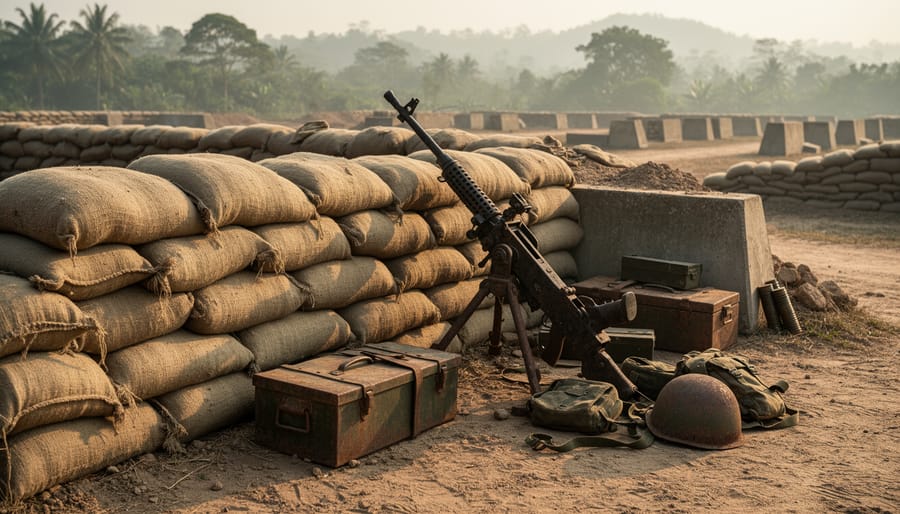
Vietnamese forces confronted a stark technological disparity during the American War. The United States deployed sophisticated aircraft, electronic sensors, heavy artillery, and chemical defoliants against an adversary lacking comparable resources. Rather than attempting symmetrical engagement, Vietnamese commanders embraced asymmetry as doctrine.
The Ho Chi Minh Trail became the logistical lifeline enabling sustained operations. This wasn’t a single route but a vast network of footpaths, truck roads, and river passages threading through Laos and Cambodia. Camouflaged beneath jungle canopy, the trail moved supplies southward despite relentless American bombing campaigns. Vietnamese engineers constructed underground fuel depots, hidden repair stations, and relay points. When B-52 strikes obliterated one segment, porters and engineers rerouted around the damage within days. By 1968, the trail channeled thousands of tons monthly to southern battlefields.
Underground warfare provided protection and tactical advantage. The Cu Chi tunnel complex near Saigon exemplified this adaptation, over 250 kilometers of passages housing command posts, hospitals, storage facilities, and living quarters. Fighters emerged to strike, then vanished underground before counterattacks materialized. These networks neutralized American firepower superiority by eliminating visible targets.
Vietnam also built a surprisingly effective integrated air defense system, beginning with Soviet-supplied SA-2 surface-to-air missiles in 1965. Operators learned to coordinate missile batteries with anti-aircraft artillery and MiG interceptors, creating overlapping kill zones. They frequently relocated batteries to prevent suppression. While America maintained air superiority, Vietnam shot down over 3,700 aircraft, forcing costly tactical adjustments and challenging the notion that technology alone determined outcomes.
These adaptations demonstrated that inferior resources need not dictate defeat when combined with strategic patience, terrain knowledge, and willingness to sustain losses while exploiting enemy weaknesses.
The Tet Offensive and Its Strategic Impact
The Tet Offensive launched on January 30, 1968, represented a coordinated assault on over 100 cities and military installations across South Vietnam during the lunar new year celebrations. North Vietnamese and Viet Cong forces attacked simultaneously, aiming to spark a general uprising and demonstrate their capacity to strike anywhere. While tactically unsuccessful, resulting in heavy communist casualties and no sustained territorial gains, the offensive achieved a strategic victory by shattering American public confidence in official claims that the war was nearly won.
The assault’s timing and scale shocked American audiences watching televised footage of fierce combat in Saigon, including the dramatic siege of the U.S. Embassy. Television journalist Walter Cronkite’s assessment that the war was unwinnable after visiting Vietnam reflected shifting public sentiment. Military commanders argued they had repelled the attacks and inflicted devastating losses, yet the offensive exposed the gap between battlefield metrics and political reality. This demonstrated how psychological impact could outweigh conventional military success, influencing approaches to modern defense achievements where public perception shapes strategic outcomes as much as tactical victories.
The Fall of Saigon and Reunification
The Spring Offensive of 1975 unfolded with unexpected speed. North Vietnamese forces launched coordinated attacks across South Vietnam in March, rapidly overwhelming demoralized Army of the Republic of Vietnam (ARVN) units. What military planners anticipated as a two-year campaign compressed into fifty-five days.
General Van Tien Dung commanded the final push toward Saigon, deploying seventeen divisions in a multi-pronged assault. The fall of Da Nang on March 30th triggered panic throughout the south. ARVN forces, stripped of American air support and facing supply shortages, collapsed faster than anyone predicted.
By late April, North Vietnamese tanks surrounded Saigon. On April 30th, 1975, tank number 843 crashed through the gates of Independence Palace at 10:45 AM. President Duong Van Minh surrendered unconditionally, ending decades of division.
The military victory achieved what generations had fought for: a unified Vietnam under a single government. The renamed Ho Chi Minh City became the economic heart of a reunified nation, though the transition proved far more complex than the swift military triumph suggested.
Post-War Military Developments and Regional Conflicts
Vietnam’s reunification in 1975 did not bring the peace many anticipated. Instead, the newly unified nation faced immediate security challenges that tested its battle-hardened military in new contexts.
The most significant post-war engagement came in December 1978, when Vietnamese forces launched a large-scale invasion of Cambodia to overthrow the Khmer Rouge regime. Pol Pot’s brutal government had conducted cross-border raids into Vietnamese territory and murdered thousands of ethnic Vietnamese civilians inside Cambodia. After diplomatic efforts failed, Vietnam deployed approximately 150,000 troops in what it termed a mission to liberate the Cambodian people from genocide.
The military campaign proved remarkably swift. Within two weeks, Vietnamese forces captured Phnom Penh and installed a new government led by former Khmer Rouge officers who had defected to Vietnam. The Vietnamese military demonstrated its ability to conduct conventional combined-arms operations, employing tanks, artillery, and air support in coordinated offensives. However, the Khmer Rouge retreated to jungle strongholds along the Thai border, and Vietnam found itself mired in a protracted counterinsurgency campaign that would last a decade.
This intervention drew international condemnation despite ending a genocidal regime. China, which had supported the Khmer Rouge, viewed Vietnam’s actions as an expansion of Soviet influence in Southeast Asia through its Vietnamese ally.
In February 1979, China launched a punitive invasion across Vietnam’s northern border with approximately 200,000 troops. The Sino-Vietnamese War lasted just 27 days but resulted in heavy casualties on both sides. Vietnamese forces, though deploying mostly regional militia and second-line units while keeping their best troops in Cambodia, fought tenaciously using defensive fortifications and familiar terrain. Chinese forces captured several provincial capitals but struggled with logistics and encountered fiercer resistance than anticipated.
Both sides claimed victory when China withdrew in March 1979, but the war achieved little beyond demonstrating the limits of military force as a political tool. Border tensions continued throughout the 1980s, with sporadic clashes over disputed territory.
Vietnam finally withdrew from Cambodia in 1989 as the Cold War ended, having lost thousands of soldiers in a conflict that isolated the country economically and diplomatically for over a decade. These post-reunification conflicts shaped Vietnam’s military doctrine and its cautious approach to regional security that persists today.
Modern Vietnamese Military: Contemporary Structure and Achievements
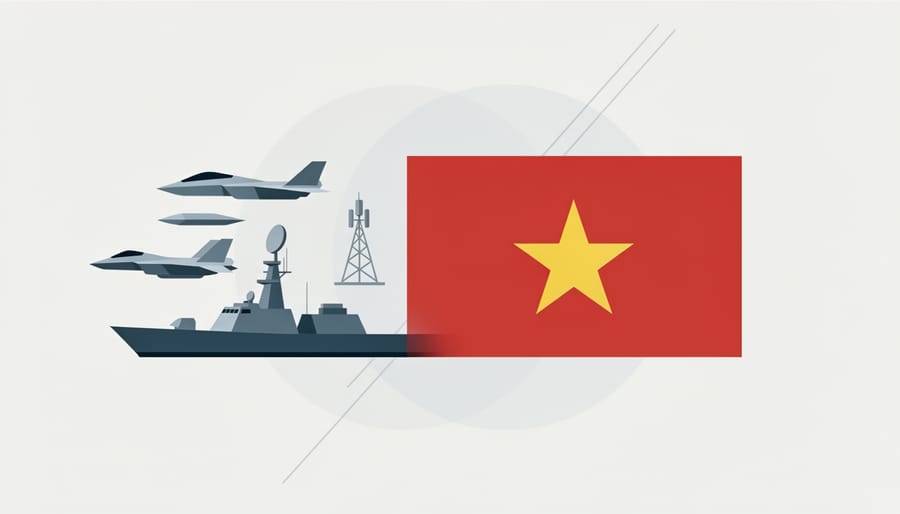
The Vietnamese People’s Army stands today as one of Southeast Asia’s most experienced military forces, shaped by decades of conflict into a disciplined institution now focused on defense modernization and regional stability. With approximately 482,000 active personnel as of 2026, the VPA has transitioned from its revolutionary origins into a conventional military structure while maintaining its doctrinal emphasis on people’s warfare and territorial defense.
Vietnam’s military modernization accelerated significantly in the 2010s and 2020s, driven by regional security concerns and the need to protect maritime sovereignty in the South China Sea. The country has diversified its defense partnerships beyond traditional suppliers, acquiring modern equipment from Russia, India, and European nations. This strategic procurement includes Kilo-class submarines, Gepard-class frigates, and advanced air defense systems that have substantially enhanced Vietnam’s coastal and maritime defense capabilities. The military has also invested heavily in domestic defense production, developing indigenous vessels, small arms, and unmanned systems that reduce foreign dependency.
| Modernization Area | Key Capabilities | International Partners |
|---|---|---|
| Naval Forces | Six Kilo-class submarines, Gepard frigates, coastal defense systems | Russia, India, Netherlands |
| Air Defense | S-300 systems, SPYDER-MR, integrated radar network | Russia, Israel, Belarus |
| Air Force | Su-30MK2 fighters, upgraded aircraft, UAV development | Russia, Israel, domestic production |
| Ground Forces | T-90 tanks, BMP-3 vehicles, artillery modernization | Russia, domestic upgrades |
Beyond hardware acquisition, the VPA has embraced international engagement as a cornerstone of its modern identity. Vietnam has participated in United Nations peacekeeping missions since 2014, deploying medical teams and engineering units to South Sudan and the Central African Republic. These contributions reflect Vietnam’s evolution from a conflict-affected nation to a responsible regional actor committed to global peace and security.
The military’s regional role emphasizes cooperation rather than confrontation. Vietnam participates actively in ASEAN defense forums, bilateral exercises with partners including India, Japan, and the United States, and maritime security initiatives that address piracy, natural disasters, and humanitarian crises. This approach mirrors broader themes of multicultural success and diplomatic engagement, positioning Vietnam as a stabilizing force in Southeast Asia while maintaining its historic commitment to independence and self-determination. The VPA’s transformation demonstrates how military institutions can adapt to new security environments while honoring their foundational principles of national defense and sovereignty.
Common Questions About Vietnam’s Military History
What was Vietnam’s greatest military victory?
Many historians point to the Battle of Dien Bien Phu in 1954 as Vietnam’s most strategically significant victory, as it ended nearly a century of French colonial rule and inspired anti-colonial movements worldwide. However, the victories against Mongol invasions in the 13th century rank among the most tactically impressive, as Vietnam was one of the few nations to successfully repel the Mongol Empire at its height.
What made Vietnamese military tactics so effective against more powerful enemies?
Vietnamese commanders excelled at asymmetric warfare, using knowledge of local terrain, guerrilla tactics, and popular mobilization to neutralize technological and numerical advantages. They integrated military operations with political strategy, turning entire populations into support networks that sustained resistance over extended periods.
Who are the most celebrated military leaders in Vietnamese history?
General Tran Hung Dao, who defeated three Mongol invasions in the 13th century, and General Vo Nguyen Giap, architect of victories at Dien Bien Phu and during the reunification campaign, stand as the most revered figures. The Trung Sisters, who led the first major rebellion against Chinese rule in 40 CE, hold a special place as symbols of resistance and national spirit.
How does Vietnam’s military history compare to other nations?
Vietnam’s military record is distinctive for its consistency of resistance against foreign domination over two millennia. Few nations can claim victories against powers as diverse as the Mongol Empire, French colonial forces, and American military might, making Vietnam’s history particularly remarkable for sustained success against technologically superior adversaries.
These questions reflect what draws many people to study Vietnamese military history: the puzzle of how a relatively small nation achieved such remarkable success against overwhelming odds. The answers lie not in any single battle or leader, but in a martial culture that evolved over centuries of conflict.
Understanding this history requires looking beyond conventional military analysis. Vietnamese military success stemmed from treating warfare as inseparable from political and social organization. Commanders didn’t just train soldiers; they mobilized entire communities, turning villages into logistical networks and farmers into part-time fighters who knew every trail and rice paddy.
This integration of civilian and military spheres made Vietnamese resistance incredibly difficult to defeat through conventional means. When one army was destroyed, another could be raised. When supply lines were cut, local communities sustained fighters through decentralized networks. The Vietnamese approach turned the population itself into a strategic asset that no amount of firepower could eliminate.
For Canadians and others seeking to understand this remarkable military tradition, the key takeaway isn’t about celebrating warfare itself. Rather, it’s about recognizing how a people’s determination to preserve their identity and sovereignty can shape innovative responses to existential threats, offering lessons in resilience that transcend any single conflict or era.
Vietnam’s military history stands as one of the most compelling narratives of sustained resistance and national determination in human experience. Across more than two millennia, Vietnamese forces defended their sovereignty against some of history’s most formidable powers, from Chinese dynasties and Mongol hordes to French colonial armies and American technological superiority. This wasn’t achieved through matching strength with strength, but through strategic brilliance, intimate knowledge of terrain, and unwavering commitment to independence.
The tactical innovations developed through centuries of asymmetric warfare, guerrilla tactics, strategic retreats, psychological operations, and mobilizing entire populations, transformed military thinking worldwide. Victories at Bach Dang River, Dien Bien Phu, and throughout the prolonged conflicts of the twentieth century demonstrated that technological advantage doesn’t guarantee success when facing determined defenders fighting on home ground.
For Canadians committed to multicultural understanding, Vietnam’s military legacy offers profound insights into how cultural identity shapes national character. The same resilience that defined Vietnamese warriors continues to enrich Canada’s Vietnamese communities today. Understanding this history deepens appreciation for the diverse narratives that build our multicultural society, while reflecting core Canadian values of self-determination and respect for peoples seeking to chart their own course.
Vietnam’s military achievements remind us that the human spirit, when defending home and heritage, can overcome seemingly insurmountable challenges, a lesson that resonates across all cultures and generations.